Nepal Flood Disaster: Duty of Care for Remote Site Workers
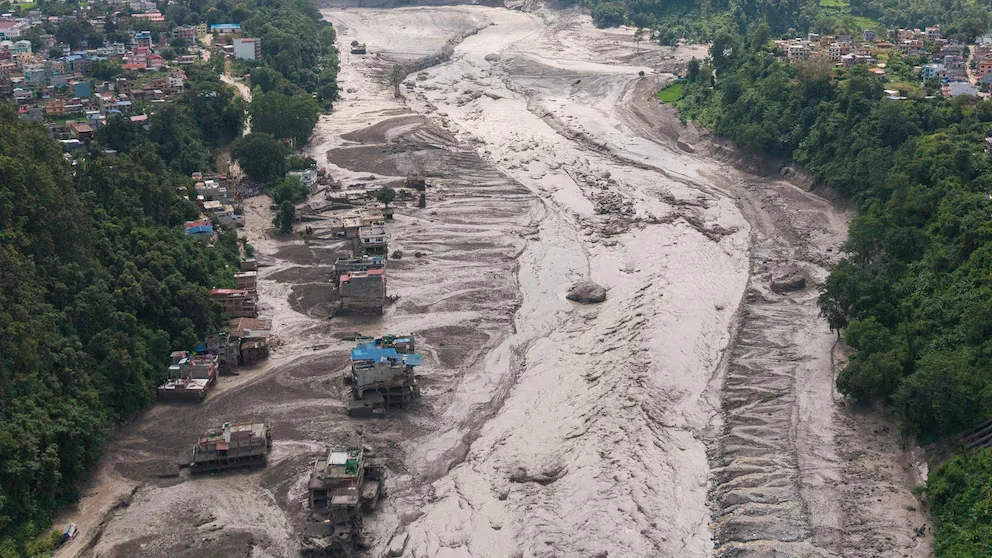
The catastrophe in Nepal’s Rasuwa District began on Wednesday, August 27, 2026, in seconds. Part of a glacier at roughly 5,200 metres in Langtang National Park collapsed, plunging about 1,200 metres before slamming into the Lende River. The resulting surge raised the Trishuli River by nine metres in 30 minutes.
Below ground, workers at the Trishuli 3A and 3B hydropower stations had no way out.
As of August 31, Nepal’s National Disaster Risk Reduction and Management Authority reports 933 hydropower workers among the missing. At least 734 bodies have been recovered across Nepal and Tibet. More than 2,498 people remain unaccounted for on the Nepalese side of the border alone, and 261 foreigners from 23 countries are among those missing. Army rescue teams have drilled into a mud-swamped tunnel at Trishuli 3A, pumping air and lowering cameras. Thermal drones have detected no signs of life.
If your company sends engineers, surveyors, project managers, or contractors to remote industrial sites, this disaster puts a direct question on the table: do you actually know where your people are right now, and do you have a plan to get them out when the ground liquefies beneath them?
What Happened in Nepal
The flood was triggered by a glacial lake outburst - a type of event that occurs when an ice dam holding back a high-altitude lake fails, releasing a catastrophic surge of water, ice, and debris. The term sounds technical. The reality is that a wall of mud, rock, and freezing water moving faster than most vehicles is heading toward everything in the valley below.
Glacial outbursts are not new to the Himalayas. Nepal’s Department of Hydrology and Meteorology has been tracking glacial lake hazards for years. What has changed is the pace of glacial retreat - which exposes more ice-dammed lakes to instability - and the density of industrial infrastructure now built in those valleys to service the region’s growing hydropower capacity.
At Trishuli 3A, army rescue teams drilled into the upper section of a mud-packed tunnel on Saturday evening. Overnight rain and rising river water flooded the excavation area before conditions eased. By Sunday, teams were back with drilling machines, excavators, and hydraulic cutters, guided by Australian geologist Arnold Dix - a specialist in underground rescues who has advised on incidents from the Lothal coal mine to the Uttarkashi tunnel collapse in India in 2023.
Nepal’s government requested specialist help from India and China to fill capability gaps. The US, Canada, UK, EU, and UN have collectively pledged more than $20m in humanitarian aid. Nepal’s finance minister estimates total losses from the disaster at over $4 billion. The rescue operation is one of the most complex Nepal has attempted, and as of Monday morning, it is still ongoing with no confirmed survivors from the tunnel sites.
Why This Is a Duty of Care Problem
Here is a question worth asking out loud: how many of the companies with workers at those hydropower sites had a documented emergency protocol for glacial outburst flooding?
That question might sound unfair - until you consider that GLOFs are a published, classified hazard in the region. The Rasuwa District appears on Nepal’s national GLOF risk maps. Trishuli River hydropower sites have been flagged in technical literature as vulnerable to upstream glacial events. This was not a surprise in the scientific sense. It was a surprise in the operational sense - which is exactly the kind of gap that employer duty of care is supposed to close.
Under ISO 31030, and under the employer liability frameworks of the UK, Australia, the EU, and increasingly North America, organizations deploying workers to remote or hazardous locations have an affirmative obligation to:
- Assess foreseeable risks specific to the site, not just generic country-level ratings
- Implement proportionate controls that address identified hazards
- Maintain a reliable system for locating and communicating with workers at all times
- Have a mass casualty response protocol that does not depend entirely on local emergency services
The Trishuli disaster exposes the gap between what many organizations say they do and what they actually have documented, tested, and resourced.
Three Duty of Care Failures This Disaster Highlights
Worker Accountability in Enclosed and Underground Environments
Do you know exactly who is on site at any given moment, and where inside that site they are?
At Trishuli 3A, rescue teams drilled into tunnels not knowing whether they would find survivors or an empty chamber. Part of that uncertainty is inherent to underground work - tunnels block GPS signals. But tunnel muster systems, RFID-based check-in logs, and hard-wired emergency communication lines are not exotic technology. They are standard practice at well-run mining operations, and they give emergency coordinators the information they need to direct effort toward where survivors are most likely to be found.
If your company operates remote industrial sites and relies on paper sign-in sheets as its primary accountability mechanism, the Trishuli disaster is a direct challenge to that practice.
Emergency Communication When Infrastructure Fails
The floods destroyed roads, blocked valley access routes, and cut normal communication channels across multiple districts. Workers trapped underground had no way to signal their location to rescue teams on the surface, and rescue teams had no way to confirm whether tunnels contained survivors before drilling.
A question every risk manager should be able to answer before deploying workers to a remote site: if mobile network, satellite phone, and site radio all fail simultaneously, what is the fallback?
The answer cannot be “we will figure it out when it happens.” The entire point of pre-incident planning is that you cannot think clearly during a mass casualty event. Decisions made under extreme pressure, with incomplete information, by people who are also managing panicked families and board-level scrutiny, are not your best decisions. Pre-agreed protocols made in calm conditions are.
No Protocol for Simultaneous, Site-Wide Compromise
Most corporate emergency response plans are designed around individual incidents: one person missing, one vehicle accident, one medical emergency. They collapse when the entire site is compromised at once.
At Trishuli 3A, the scale of the event immediately overwhelmed local emergency services. Nepal’s army, Indian rescue teams, Chinese specialists, and international advisers have all been working in parallel - and it took four days before any drilling reached a tunnel entrance. An organization that had a pre-existing contract with an emergency evacuation partner and a mass casualty specialist would have been positioned to mobilize resources within hours, not days.
The difference between four hours and four days, in an underground flooding scenario, is almost certainly the difference between survivors and casualties.
What Employers in High-Risk Industries Must Do Now
If your workforce includes people working at remote construction sites, hydropower facilities, mining operations, oil and gas installations, or infrastructure projects in geologically active or flood-prone regions, the following actions are not optional.
Commission a hazard-specific site risk assessment. Standard country risk ratings cover crime, political stability, terrorism, and health. They do not tell you about glacial lake outburst risk, seismic exposure, or flood plain proximity. For any site in a geologically active region, you need a site-specific assessment that addresses the actual physical hazards present. If your existing risk assessment does not mention the specific geological hazards at each location, it is incomplete.
Verify your worker accountability system works without mobile connectivity. Test your muster process with no network access. If it depends on smartphones or internet connectivity, you have a gap. For underground or enclosed sites, confirm that you have a method for locating workers who cannot physically reach the surface or an exit point.
Pre-position emergency resources. Know which medevac provider covers your remote sites, confirm their response time to your specific location, and verify they can operate in the environmental conditions your site is exposed to. For high-altitude Himalayan sites, helicopter medevac has altitude and weather limitations that can ground aircraft for days. Know this before an incident. Document it. Brief your site managers.
Write a mass casualty protocol. Define in advance: who makes decisions if ten or more people are injured or missing simultaneously? Who contacts families? Who coordinates with local and national authorities? Who manages media inquiries? Who initiates insurance notification? This protocol needs to exist as a written document, reviewed by legal and HR, and distributed to site managers. An implicit assumption that “someone senior will handle it” is not a protocol.
Test your emergency notification tree. The worst time to discover that your emergency contact list is six months out of date is when you are trying to reach your site manager at 3am. Run an unannounced test. Confirm that satellite phones are charged, that emergency numbers are current, and that your incident response chain is intact.
Brief workers on site-specific hazards at induction. Workers at flood-prone or geologically active sites should understand the specific hazards they are exposed to before they start work, not after an incident begins. That briefing is both a legal record and a practical safeguard. For workers operating underground, the briefing should include tunnel evacuation routes, muster procedures, and the location of emergency communication equipment.
The 261 Foreigners That Nobody Has Named Yet
One detail from the Nepal disaster has received relatively little coverage: 261 foreigners from 23 countries are among those missing in Nepal and Tibet. Their nationalities have not been fully disclosed, but the presence of international workers at Himalayan infrastructure projects is well-established. Chinese-funded hydropower developments across Nepal routinely employ specialists from mainland China, South Asia, Southeast Asia, and occasionally Europe and Australia.
Many of those 261 people were deployed to remote Himalayan locations by organizations that assumed local project management was handling the risk. That assumption is among the most expensive a company can make.
Duty of care obligations under most legal frameworks follow the employee or contractor regardless of who manages the physical site. If your company benefits from the work being done there, your duty of care extends to the worker doing it.
What Happens Next
Nepal’s rescue teams will continue working. The final death toll will almost certainly be higher than current figures reflect. International humanitarian response will ramp up over the coming days, and the long-term reconstruction effort will run for years.
For risk managers and security directors, the work is different. The window to update your remote site protocols is before the next event, not after it. GLOF events in the Himalayas are increasing in frequency. So are flash floods driven by monsoon intensification across South and Southeast Asia. If your company has operations in any of these regions, the Trishuli disaster is not a remote tragedy - it is a case study in what happens when site-specific hazard planning lags behind the physical reality on the ground.
Knowing where your people are, in real time, is the first requirement of remote site duty of care. HAAVYN’s platform combines real-time threat intelligence from 1,200+ monitoring sources across 220+ countries with mobile-first safety tools including SOS alerts, welfare check-ins, and automated emergency notification - all designed to function in environments where standard infrastructure is unreliable or absent.
For organizations with workers in extractive industries, engineering and construction, or remote-site operations, HAAVYN also integrates malicious risk and political violence insurance - providing a financial safety net alongside the operational safety layer.
The rescue teams at Trishuli are working around the clock. The question for every organization with remote-site workers is the same one it has always been: when the ground gives way, are your people covered - or are you hoping the local emergency services get there first?
Talk to HAAVYN about duty of care for your remote site operations.